August 2026 F5P Data Highlights

Top 5 Micro-Markets to Watch Right Now
Boone County, IN | Meta's $10 Billion Bet Turns Farmland Into an AI Corridor
Meta broke ground in February on a $10 billion, 1,500 acre data center campus in Lebanon, one of its largest infrastructure investments to date and a major anchor project inside Indiana's LEAP Innovation and Research District. The roughly 4 million square foot complex will include 13 buildings, including 10 dedicated data center structures, and deliver 1 gigawatt of computing capacity once fully operational. Construction is expected to support more than 4000 workers at peak, with roughly 300 permanent operational jobs once running. It is Meta's second Indiana project, following an $800 million Jeffersonville facility, and adds another major investment to the rapidly expanding LEAP district. For a county of roughly 70k people, that construction workforce could pressure local rental supply well before the permanent jobs arrive.
Millard County, UT | A Pork Plant Closed. A $17 Billion Data Center Is Filling the Gap
Millard County lost its largest employer when a Smithfield Foods pork plant closed in 2023, taking roughly a quarter of local jobs with it. Now Creekstone Energy is developing what it calls the Creekstone Gigasite, a $17 billion power and AI data center campus in Millard County designed around its own on-site power generation rather than relying entirely on the local grid. The project is expected to create 106 permanent jobs, modest by data center standards, but it arrives alongside a separate 4k acre data center campus being developed by Joule Capital Partners. County officials see the projects as an opportunity to replace lost industrial activity and expand the local tax base. For a rural county reshaping its economy twice in three years, construction spending is the more immediate story than permanent headcount.
Catawba County, NC | Prysmian's Expansion Signals a Manufacturing Base Doubling Down
Prysmian is investing more than $1 billion and adding 385 jobs at its fiber and cable manufacturing plant in Claremont, the largest manufacturing investment announced in Catawba County history. Average pay for the new positions is projected at $60,870, about $3,900 above the county's current average salary. The expansion will add roughly 900k square feet, including a new glass manufacturing facility, expanded fiber optic cable production and new research and development space. The Italy-based cable and fiber giant operates more than 100 plants worldwide and currently employs about 680 people at the Claremont facility. The expansion is being driven in part by rising demand for fiber and optical cable from data centers and other digital infrastructure projects. For a county already home to a substantial manufacturing base, several hundred new positions at above average wages should support continued household formation in the Hickory area.
Harris County, TX | Apple's Houston Campus Turns AI Server Production Into Reshoring Proof
Apple opened its Advanced Manufacturing Center inside its Houston manufacturing complex in August, expanding a site that already produces and ships advanced AI servers. The center is Apple's second U.S. manufacturing learning site and provides hands-on training for small and medium sized businesses, workers and students. Apple began producing advanced AI servers in Houston in 2025, shipping its first units ahead of schedule, and plans to begin U.S. production of the Mac mini later this year, the first time the device will be manufactured domestically. The Houston manufacturing operation includes a 250k square foot server manufacturing facility, while the new Advanced Manufacturing Center itself spans 20k square feet. Apple says the expanded Houston operations will create thousands of jobs and that it has invested hundreds of millions of dollars into the facility in less than nine months. For a metro with a large industrial workforce and extensive manufacturing infrastructure, sustained hiring here could anchor demand beyond the energy sector Houston is known for.
Louisa County, VA | Amazon's Virginia Data Center Bet Is Already Reshaping Rural Louisa
Amazon Web Services originally announced an $11 billion investment in Louisa County through 2040 to develop two data center campuses inside the county's Technology Overlay District, as part of its broader $35 billion Virginia commitment. Those two campuses, Lake Anna Technology Campus and North Creek Technology Campus, are now underway, according to the county. AWS also proposed a third campus in 2025 that would have included up to 7.2 million square feet of data center space, but that proposal was subsequently withdrawn following community opposition. The county's Technology Overlay District was specifically designed to accommodate large technology projects while preserving buffers from residential areas and limiting their impacts on the county's rural character. For a county historically defined by agriculture and small town development, even the original AWS commitment represents a major potential shift in its tax base, infrastructure needs and housing demand.
BTR construction pulls back even after congress backed off
Single-family built-for-rent starts fell to about 15k in the second quarter of 2026, down from 18k a year earlier, as higher financing costs, increased multifamily supply, and policy uncertainty weighed on parts of the BTR development market. Over the four quarters through June, roughly 63k BTR homes began construction, down 16% from the 75k started in the prior four-quarter period. The legislative threat also receded: the House ultimately removed the Senate provision that would have restricted institutional capital from financing BTR housing, and the final housing law does not include that prohibition. The pullback happened anyway. BTR's four-quarter moving average still accounts for just under 7% of single-family starts, well above its long-run historical average of 2.7%, suggesting the segment remains structurally larger than it was before the post-Great Recession expansion, even as financing and supply conditions slow the pipeline.
National population growth hits slowest pace since pandemic due to reduced migration
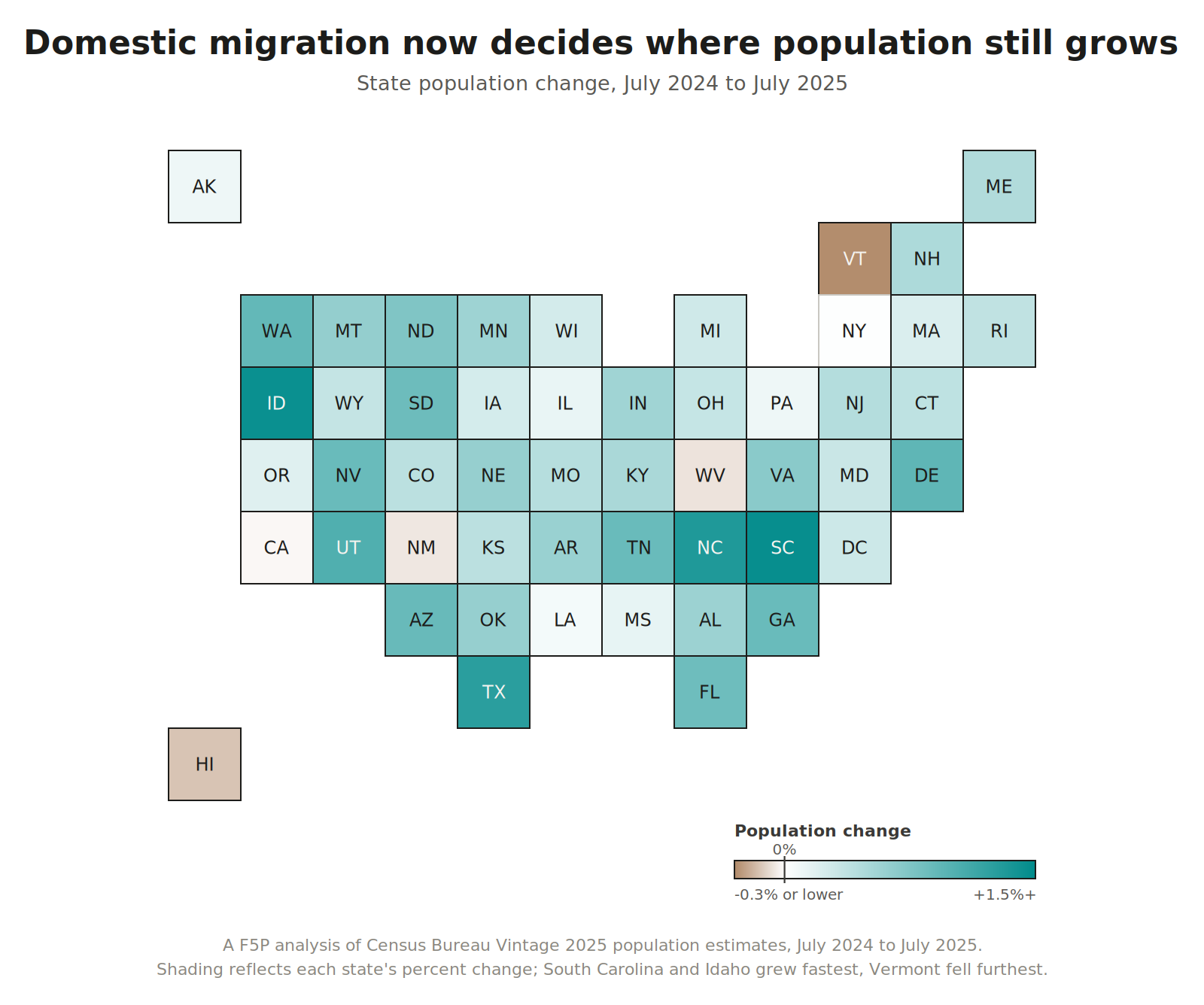
The U.S. population grew just 0.5% between July 2024 and July 2025, the slowest pace since the early pandemic, adding about 1.8 million people compared with 3.2 million the previous year. The slowdown was largely driven by a historic decline in net international migration, which fell from roughly 2.7 million to 1.3 million, while natural change remained relatively stable at about 519k. If current trends continue, the Census Bureau estimates net international migration could fall to roughly 321k by July 2026. The effects are not spread evenly. South Carolina, Idaho, and North Carolina posted the nation's fastest population growth, while 31 states still recorded positive net domestic migration. California, New York, New Jersey, Massachusetts, and Illinois remain among the states that have experienced substantial population losses or slower growth over the longer term. California's losses ran deep enough that the state posted an outright population decline in 2025: domestic outmigration of nearly 230k, combined with a sharp drop in net international migration, overwhelmed positive natural change of nearly 110k. For multifamily underwriting, the takeaway is less a simple Sunbelt-versus-Northeast divide than a growing need to underwrite population sources market by market. As international migration contributes less to national growth, domestic migration becomes an increasingly important differentiator in renter-demand forecasts.