May 2026 F5P Data Highlights

Top 5 Micro-Markets to Watch Right Now
Loudoun County, VA | The Data Center Capital of America Reckons with Its Housing Squeeze
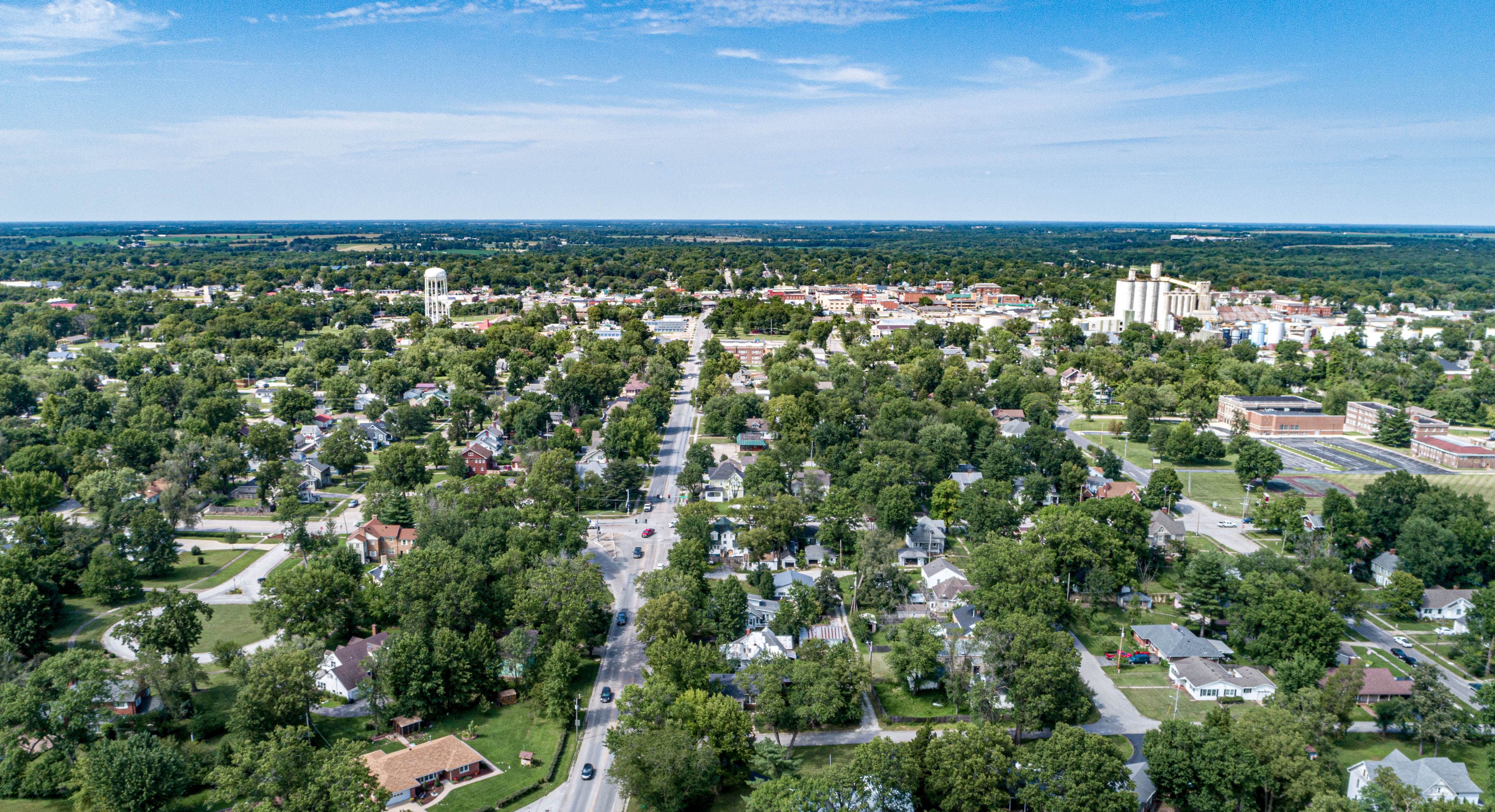
Loudoun County, Virginia, hosts more data center capacity than any jurisdiction on earth, and that infrastructure concentration is now producing a distinct housing problem. The county's commercial tax base, swollen by hyperscale facility investments from AWS, Microsoft, and Google, has allowed local government to maintain strong school funding and public services, reinforcing its residential desirability. But the same industrial land conversion driving data center growth is reducing available residential development parcels. Median home prices in Loudoun have held above $700K through early 2026, supported by the county's concentration of federal contracting and technology workers. Loudoun is effectively running a premium suburban model funded by commercial real estate, and the tension between that industrial land appetite and housing supply is becoming the county's central planning challenge.
Cherokee County, GA | Atlanta's Northern Edge Reaches Critical Mass
Cherokee County is outgrowing its identity as a commuter-only suburb. The county's population surpassed 290K in 2025, and employer interest has expanded as well. Manufacturing expansion along the Highway 92 corridor and healthcare system growth anchored by Northside Hospital Cherokee are adding high wage jobs locally, reducing income dependence on Atlanta commuters. Median home prices are approaching $450K, up roughly 40% since 2020, though they remain meaningfully below Cobb and Forsyth County levels. Canton, the county seat, is seeing its first wave of mixed use downtown investment in a generation. The combination of in-county employment growth, relative affordability, and strong school district performance is sustaining demand across both entry level and move-up segments.
Dane County, WI | Capital City Stability Backed by Research Economy Depth
Dane County is among the Midwest's quietest overperformers. Home to Madison and the University of Wisconsin flagship campus, the county has maintained low unemployment and steady home price appreciation even as much of the Upper Midwest softened. Median home values crossed $380K in 2025, with limited resale inventory creating consistent pressure on the for-sale market. The county's housing policy debate has sharpened: Madison's city council passed a zoning reform package in late 2025 allowing higher density residential construction in previously single family zones, a shift that could meaningfully expand the supply pipeline over the next several years. The university's research commercialization ecosystem continues to seed life sciences and software startups, diversifying an employment base historically anchored by government and education. Dane County's institutional stability, policy driven supply reform, and knowledge economy depth make it one of the more durable Midwest housing markets to watch.
Placer County, CA | Sacramento's Growth Premium Shifts Eastward
Placer County is capturing an increasingly defined migration stream: California residents priced out of the Bay Area who still want proximity to a major metro, but for whom Sacramento proper feels either too urban or too expensive at its western edge. Cities like Rocklin, Roseville, and Lincoln have absorbed consistent household inflow since 2021, and the county's housing market proved more resilient than most of coastal California during the rate driven correction. Median home values stabilized in the $580K to $620K range through 2025 and showed modest appreciation in early 2026. Major expansion at Sutter Health's Roseville campus and continued growth at Sierra College are providing local employment anchors. Placer County is benefiting from a structural shift in Bay Area household preferences without the boom-bust volatility that has historically characterized California's inland markets.
Gallatin County, MT | A Pandemic Boomtown Recalibrates
Between 2019 and 2022, median home prices in Gallatin County jumped from $398K to $699K, a 76% increase in three years. That run is now firmly in the rearview. By March 2026, the county's median sale price had pulled back to $658K, down 11% year-over-year, while days on market shortened from 117 to 100 days and transaction volume picked up, with 151 homes sold compared to 104 in the same month a year prior. The correction is being shaped by more than rate sensitivity. Inventory has climbed to 1,060 unsold listings, a level not seen since 2011, while population growth has slowed to a projected 0.3% to 0.4%, the weakest pace in 25 years. Montana's new 2026 Homestead and Long-Term Rental tax structure, which shifts more of the tax burden onto second homes, is adding a policy dimension to the market's reset. Gallatin County still runs 76K payroll jobs and a 2.9% unemployment rate, suggesting the underlying employment base remains intact even as the hype cools.
The rent-vs-own calculus is changing. Here’s what it means for MFR
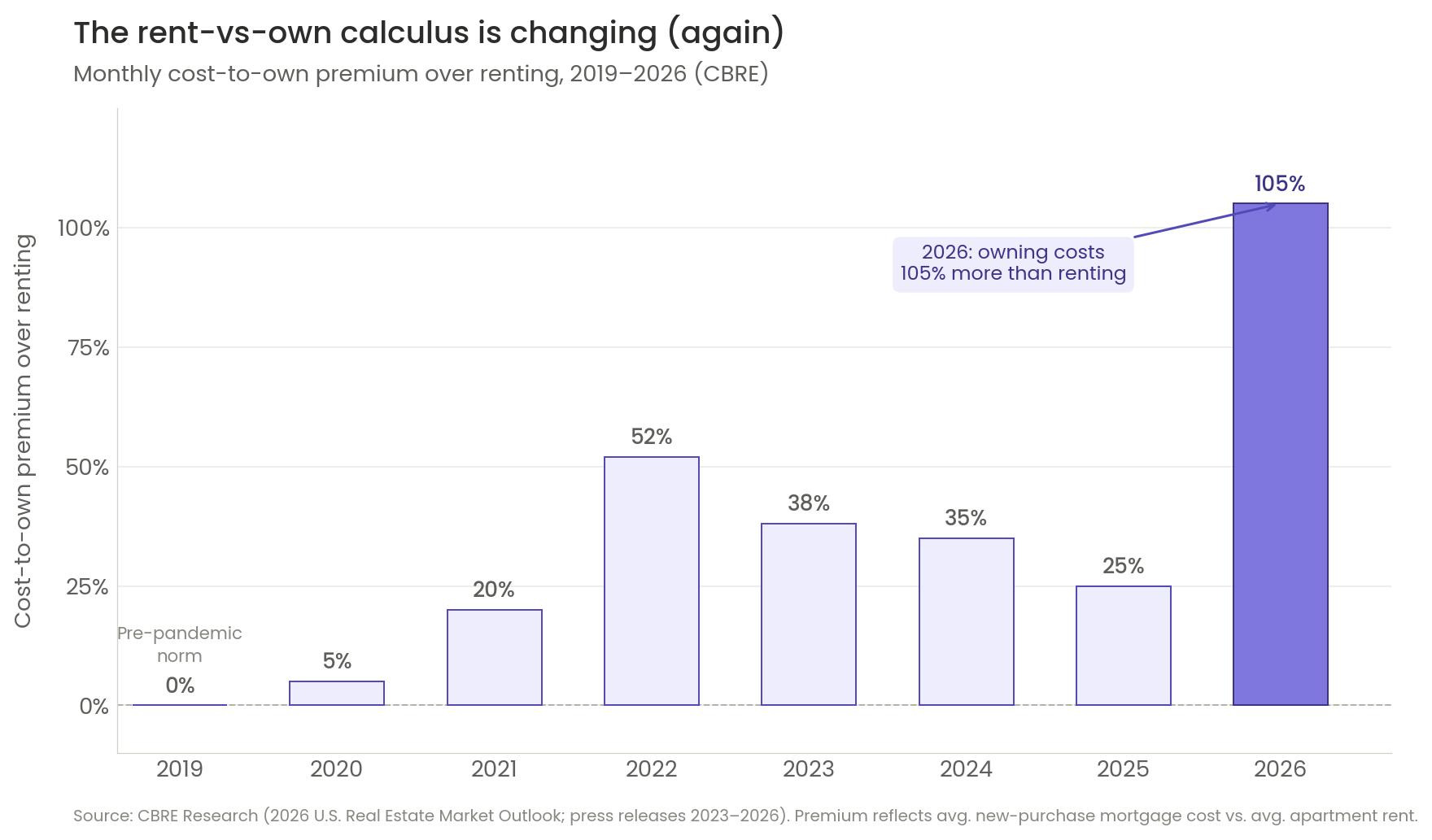
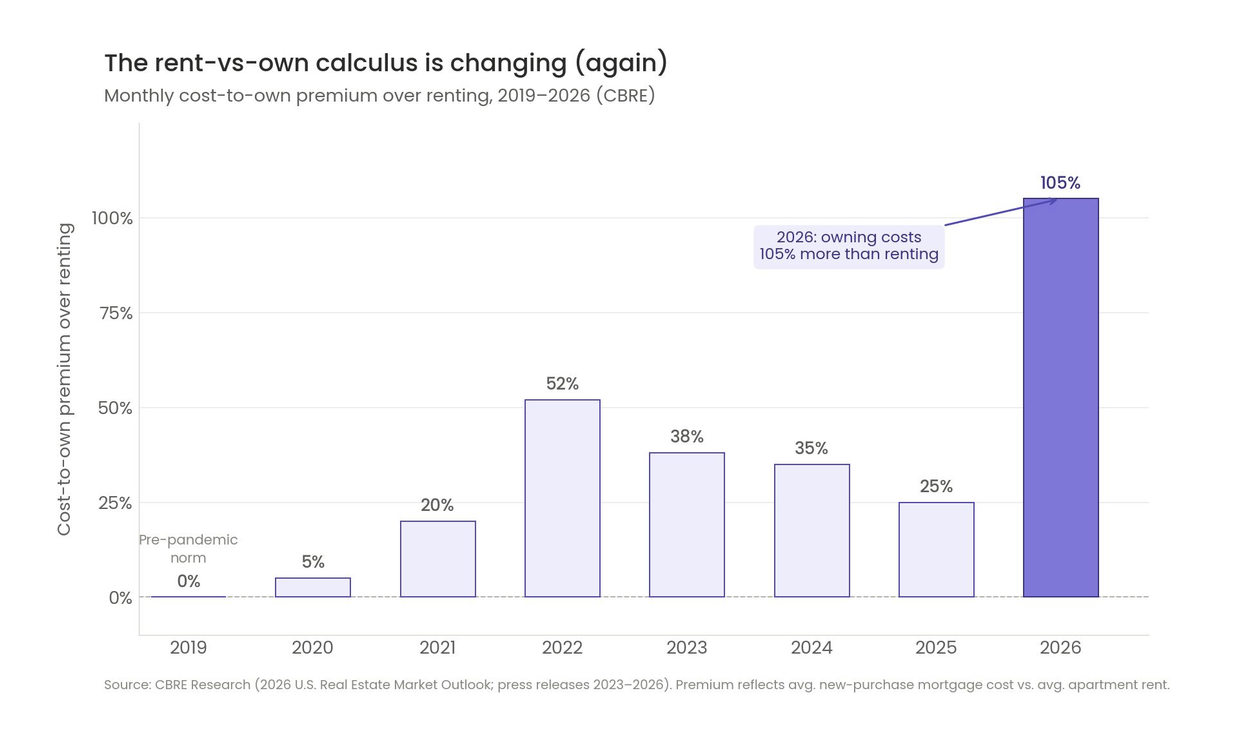
For much of the post-pandemic years, renting was the obvious financial default. That calculus is getting more complicated. The monthly cost of homeownership now runs roughly $920 more than average apartment rent, and only about 12.7% of renters can actually afford to buy a median priced home in their market.
The lock-in effect is extending rental tenure even among households that could theoretically qualify to buy. Renters are increasingly skeptical about ownership: just 34.7% now report expecting to own a primary residence at any point in the future, per the New York Fed's SCE Housing Survey. For multifamily operators, longer average tenancies and stronger renewal rates are the direct result. Lease renewal rates are already running above long-term averages nationally, and with multifamily construction starts down 53% from their 2023 peak, the supply side is tightening behind this demand. The conditions for a durable occupancy recovery are falling into place.
The hidden cost driving MFR investors from Sun Belt markets
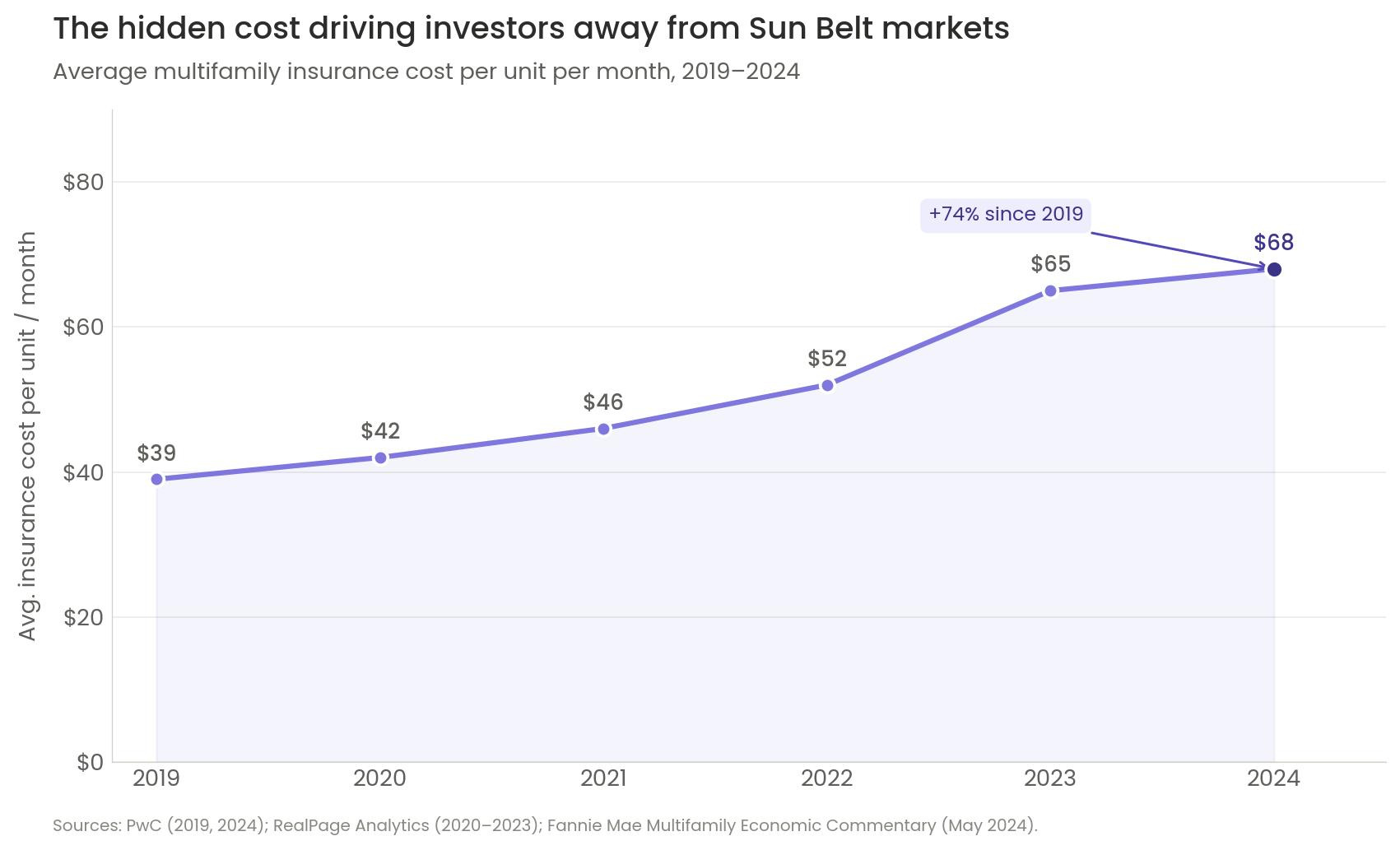
Insurance has quietly become one of the most disruptive line items in multifamily underwriting. Before the pandemic, average multifamily insurance costs ran around $30 per unit per month. By late 2023 that figure had climbed to approximately $65: a 119% increase in four years, according to RealPage. The pressure has been sharpest in climate-exposed Sun Belt markets, where insurance costs as a percentage of NOI have reached as high as 7% in parts of Florida, a meaningful drag on returns that wasn't priced into many acquisitions made during the 2021 to 2022 runup. The picture is mixed heading into the second half of 2026. In California, some major insurers have sought or received approval for rate increases of roughly 7% as regulators work to stabilize the market, while deductibles are rising elsewhere, meaning operators may be getting less coverage even where headline premiums appear to be flattening. For investors underwriting Sun Belt deals today, insurance is no longer a rounding error. It is a core assumption that can meaningfully move returns.