June 2026 F5P Data Highlights


Top 5 Micro-Markets to Watch Right Now
Sandoval County, NM | Intel's Chip Money Reshapes Rio Rancho
Rio Rancho grew 8.1% between 2020 and 2024, the strongest population gain of any city in New Mexico, and much of it traces back to one company. Intel is investing $3.5 billion to expand its Fab 11X semiconductor plant, one of its largest advanced packaging facilities, and recently amended its 45-year-old lease with Sandoval County to extend investment through 2030 and add a new payment-in-lieu-of-taxes structure worth $9 million over 10 years. The county has moved just as fast on land use, rezoning hundreds of acres for industrial development under missile facility project Project Ranger and designating two new "site ready" parcels this spring to attract the next wave of manufacturers. Homebuilders are following the jobs: Sandoval County now captures nearly half of all new home starts across the greater Albuquerque metro, a share builders expect to keep climbing.
Clark County, WA | Vancouver Rewrites Its Zoning Rulebook
Vancouver's City Council adopted a sweeping new comprehensive plan and zoning code on June 1, replacing 17 residential zones with 10 new districts built to accommodate 81k new residents and 38k new homes by 2045. The overhaul scraps large-lot, single-family-only zones like R-2 and R-4 in favor of denser districts, some allowing fourplexes or sixplexes near transit. It follows three years of public engagement and more than 100 community meetings, alongside a separate county effort permitting duplexes and triplexes in unincorporated growth areas like Hazel Dell and Salmon Creek. The changes reflect a broader Pacific Northwest pattern, with Oregon mandating middle housing statewide and Washington cities from Tacoma to Spokane following suit. For a market historically defined by no-income-tax appeal for Portland commuters, Vancouver's rezoning marks one of the region's most consequential supply-side experiments to watch through 2026.
Kent County, MI | Grand Rapids Builds Through a Manufacturing Handoff
Kent County has led Michigan in raw population growth since 2020, adding roughly 33,600 residents even as the state overall is projected to shrink. The region's "eds and meds" economy, anchored by Corewell Health, Grand Valley State University, and a manufacturing base that survived the auto industry's struggles, has kept demand resilient enough that homeowners locked into sub-4% mortgages are staying put, choking off resale inventory. County commissioners have responded with a revolving loan fund, zoning reform incentives, and a countywide brownfield redevelopment authority, though the housing gap still sits near 34k units through 2030. The market's biggest test looms: Steelcase, a Grand Rapids manufacturing fixture since 1912, is being absorbed by Iowa's HNI Corp in a $2.2 billion deal that could shift jobs out of state, a rare crack in an otherwise steady growth story.
Horry County, SC | Fastest-Growing Strand Hits Its Limits
Horry County's population has surged 64% since 2010 to an estimated 443k, keeping the Myrtle Beach metro among the nation's fastest-growing for years running. Builders authorized more than 6,500 new housing permits in 2025 alone, yet growth has outpaced the infrastructure meant to support it: county officials project 21 area schools will hit or exceed 95% capacity, and some Carolina Forest schools are already projected above 130%. The county is now weighing changes to development impact fees, aiming to shift more infrastructure cost onto new construction rather than existing taxpayers. Climate pressure on Florida's insurance market may push even more migration toward the Grand Strand in coming years, but local sentiment is shifting from welcome to wariness, with drainage, traffic, and school capacity emerging as the defining political fights of 2026.
New Castle County, DE | The Quiet Bedroom Community for Two Cities
New Castle County's population has grown to roughly 590k, expanding steadily as Delaware's unique tax structure draws professionals commuting into both Philadelphia's financial district and Baltimore's harbor. Corridor towns like Middletown, Bear, and Pike Creek are seeing new construction and infrastructure investment tied to that dual metro pull. The state's Downtown Development District program was expanded this year from 12 to its full allowable 15 districts, opening qualified investment incentives to more municipalities statewide, while a new gubernatorial executive order launches a 2026 smart growth visioning process to coordinate land use planning across all 60 local jurisdictions. For a county historically overshadowed by Delaware's beach town headlines further south, this quiet convergence of tax policy and commuter demand is building one of the Mid Atlantic's more durable, underappreciated growth stories.
Two Americas: Multifamily Markets Are Splitting in Two
The multifamily market looks like it's recovering. The metro-level story says otherwise. Austin carries a multifamily vacancy rate of 13.7%, with rents down 4.8% year over year, the steepest decline in the country. New York's vacancy rate sits at just 3.1%, the lowest nationally, backed by roughly 27,850 units of trailing twelve month absorption, the strongest of any metro. The split runs along familiar lines. Oversupplied Sun Belt and Mountain West markets are still working through a construction hangover. Midwest and Northeast markets, where building stayed measured, are pulling ahead. Six of the ten U.S. markets with the strongest multifamily rent growth over the past year sat in the Midwest, led by Chicago, Columbus, and Kansas City. For BTR and multifamily investors, this isn't a temporary blip. Recovery timing now depends on where a project sits, not just when it was built. Absorption is expected to overtake deliveries nationally by late 2026, but the most oversupplied Sun Belt markets may not get there until 2027 or later.
Congress Just Rewrote the Rules for Build to Rent

The largest housing bill in decades just passed Congress, and BTR came out ahead. The House passed the 21st Century ROAD to Housing Act 358 to 32, a day after the Senate approved it with similarly overwhelming bipartisan support. Earlier drafts would have forced BTR operators to sell off communities after seven years and given renters a right of first refusal. The final bill dropped both provisions, along with the forced disposal requirement, while keeping restrictions on large investors buying existing single family homes. The bill also raises FHA multifamily mortgage insurance loan limits for the first time in over two decades, letting developers borrow more against FHA-insured construction and acquisition loans. That's a direct lever for higher density production, though the real impact depends on market conditions and FHA capacity. For BTR investors, the headline takeaway is relief. The provision that worried the industry most didn't survive reconciliation.
Multifamily's New Underwriting Input: Flood Insurance Costs
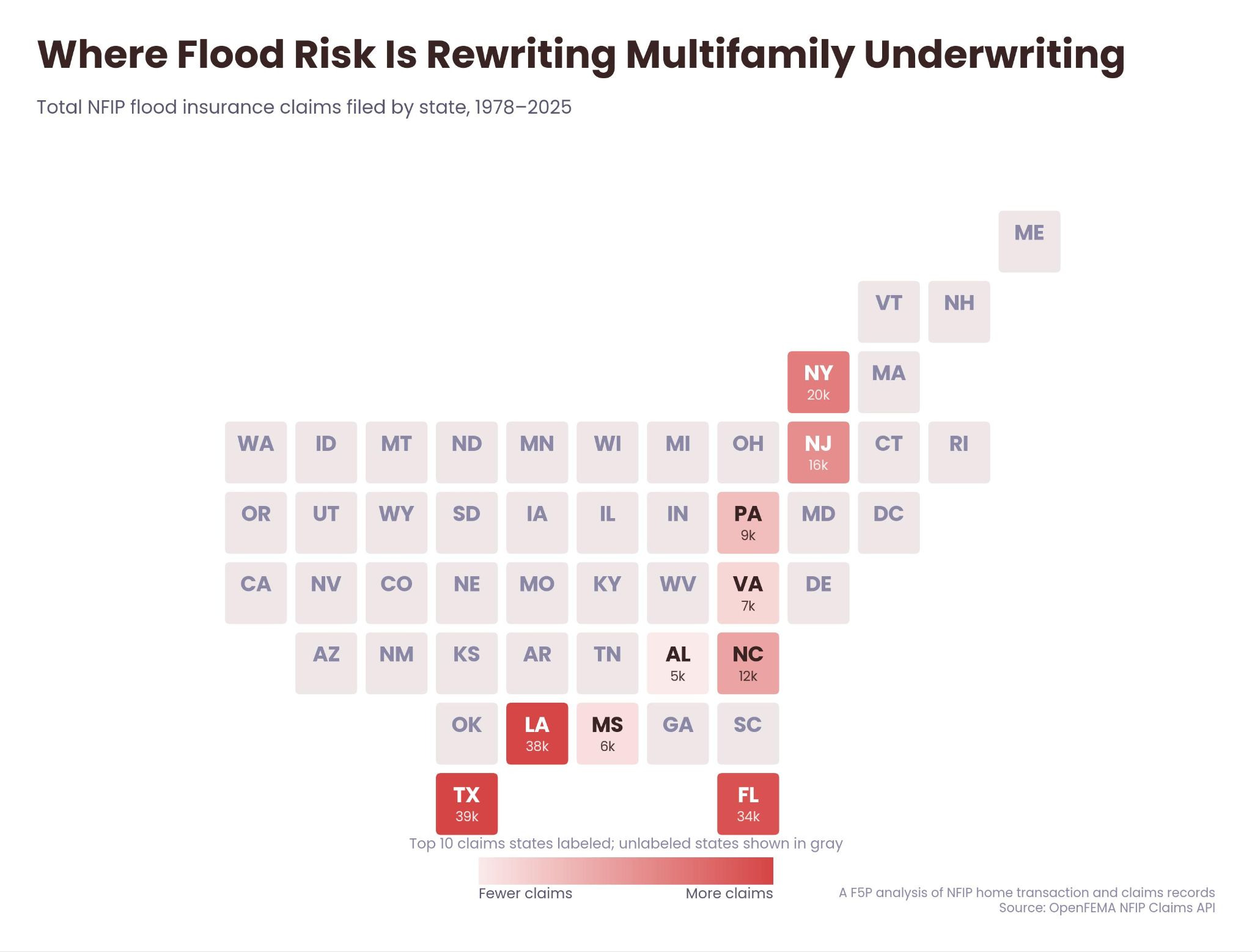
FEMA quietly rewrote the insurance math on entire multifamily submarkets. Since Risk Rating 2.0 rolled out in October 2021, new flood insurance purchases have dropped by up to 39%, and 77% of policyholders are now paying higher premiums, trends already showing up in multifamily operating budgets. Exposure concentrates where supply is already tight: flood-prone corridors across the South and coastal regions. For multifamily operators, insurance is no longer a fixed line item, it is a variable one that can erode NOI mid-hold.
A property that pencils out at today's premiums may not pencil out at next year's reassessment. Insurers are still catching up to updated FEMA maps in many counties, so premium shocks often land after acquisition or stabilization. Lenders are tightening underwriting on loans in newly reclassified zones. Flood risk pricing is becoming a primary underwriting input. Markets that look attractive on cap rate alone can still carry outsized exposure once flood risk gets priced in.