March 2026 F5P Data Highlights


March 2026 | Micromarkets to watch
Denton County, TX | DFW's Northern Frontier Adds a New Growth Engine
Denton County sits at the leading edge of the Dallas-Fort Worth expansion, capturing households priced out of Collin and Tarrant counties while building its own employment base. Median home prices hover near $430k, supported by the University of North Texas medical presence and downtown revitalization. The larger signal for the county's long-term trajectory is Landmark: a $10 billion, 3,200-acre master-planned community being developed by Hillwood along I-35W near Argyle. Phase one broke ground in November 2025, delivering 700-plus single-family homes, an H-E-B-anchored retail center, and a STEM park. At full build-out, the project adds 6000 homes and roughly 900 acres of commercial space. With 43 multifamily projects in various stages of development countywide and DFW adding 40-50k jobs annually, Denton is transitioning from a bedroom community to a jobs-and-housing node in its own right.
Hamilton County, OH | Cincinnati's Corporate Foundation Supports Steady Appreciation
Hamilton County is home to one of the Midwest's most quietly durable housing markets. Cincinnati's economy is anchored by nine Fortune 500 companies, including Kroger, Procter & Gamble, and Macy's, providing an employment base that has historically insulated the market from sharp corrections. Home prices rose approximately 6.7% year-over-year through mid-2025, and the median sold price across Greater Cincinnati hit $300k in January 2026, a 10% jump from a year prior. Homes are trading at a median of six days to pending, with more than a third closing above list price. Inventory remains tight at roughly 3.6 months of supply. Progress on the long-delayed Brent Spence Bridge corridor is reinforcing investor confidence in the region's infrastructure trajectory. Hamilton County does not make national headlines, but it consistently delivers what income-focused investors value most: diversified employment, controlled supply, and stable appreciation.
St. Johns County, FL | Florida's Top School District Anchors a Durable Growth Story
St. Johns County, just south of Jacksonville, has emerged as one of Northeast Florida’s most desirable housing markets, driven by strong in-migration and consistently top-ranked public schools. The district regularly ranks among the best in Florida and significantly outperforms neighboring Duval County on key academic metrics. This school quality premium is reflected in home prices, with St. Johns properties generally commanding higher values than comparable homes in Duval County. Master-planned communities like Nocatee and the expanding Silverleaf corridor continue to attract relocators from the Northeast and Midwest. Combined with regional job growth in logistics and financial services, these factors have supported sustained housing demand, although specific market conditions can vary year to year.
Wake County, NC | The Research Triangle Keeps Adding Residents and Jobs
Wake County recently surpassed 1.2 million residents and remains one of the fastest-growing counties in the Southeast, driven by sustained in-migration and a strong employment base anchored by the Research Triangle Park. The region supports tens of thousands of high-skill jobs across technology, life sciences, and financial services, with major employers including Cisco and Fidelity and continued expansion from firms like Apple. Housing inventory has risen from pandemic lows, giving buyers more options, though long-term demand continues to pressure supply. Infrastructure investments such as the Complete 540 expansion are improving access to southern and western submarkets, supporting growth in areas like Apex and Fuquay-Varina. Large-scale developments like Veridea are adding mixed-use density and future employment nodes. With median home prices in the low-to-mid $400,000s, Wake County remains a leading growth market in the Southeast, though near-term appreciation will depend on broader economic and interest rate conditions.
Douglas County, CO | Denver's Most Affluent Suburb Holds Its Ground
Douglas County has long been Colorado's premier suburban market, and the fundamentals supporting that position remain intact in 2026. Castle Rock, Parker, Highlands Ranch, and Lone Tree continue attracting professionals working in the Denver Tech Center as well as relocators seeking top-tier schools and mountain access at prices below Boulder or central Denver. Colorado home prices statewide are forecast to grow 3% to 5% in 2026, with Douglas County expected to track toward the stronger end of that range given its school quality premium and constrained resale supply. New construction remains active in Castle Rock's growth corridors, providing a release valve for entry-level demand. Denver's diversified employment base across aerospace, energy, financial services, and healthcare underwrites regional housing demand, and Douglas County consistently captures the highest-income tier of that workforce.
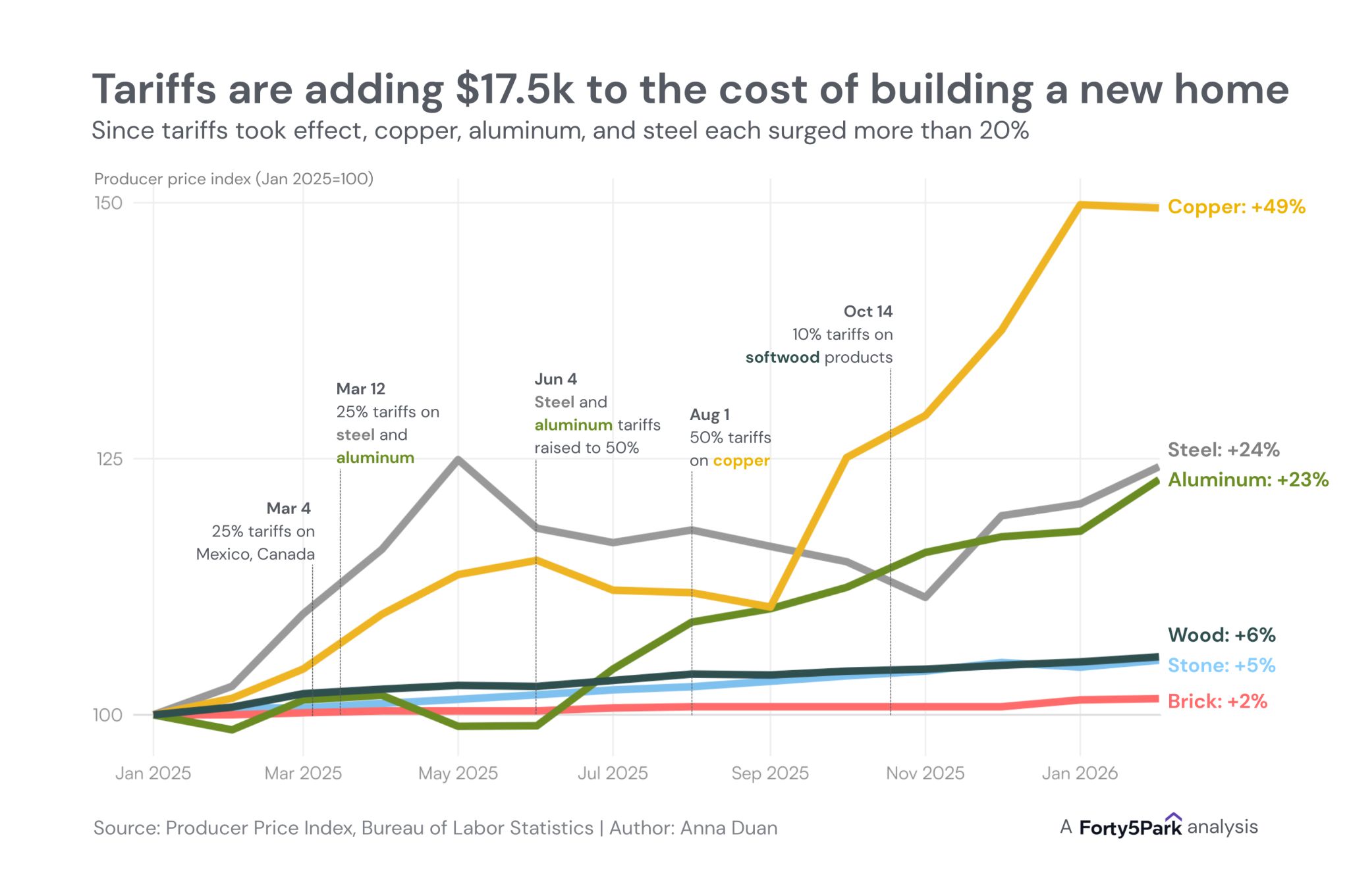
Tariffs are adding $17,500 to the cost of each new home in the U.S.
The cost of materials used to build homes has risen 40% since December 2020. NAHB reports that over 60% of builders have already seen suppliers raise prices due to tariffs, directly impacting project feasibility and timelines. The U.S. already faces a structural shortage of more than 5 million homes, based on estimates from Zillow and Brookings. Closing that gap requires sustained, high levels of new construction. But higher input costs are slowing that process.
The pressure is coming from key materials. The U.S. depends heavily on imports for construction inputs, especially lumber, with Canada supplying about 85% of imports. Recent tariff increases have pushed those costs higher. At the same time, steel and aluminum tariffs rose to 50% for many countries in 2025, further elevating construction expenses across the board.
Research from Harvard’s Joint Center for Housing Studies underscores that builders are already navigating high interest rates, elevated material costs, and market uncertainty, all of which are constraining new supply.
Tariffs are not the root cause of the housing shortage, but by raising per-unit costs, they are directly limiting the pace at which new homes can be built.
Two housing markets: What Miami's Home Transactions Reveal About the Luxury Divide
Across the U.S., housing has split into two markets. Rising inventory and elevated mortgage rates have cooled broad-based demand, while cash-driven luxury activity has remained resilient. Miami, now one of the country’s most active luxury markets, offers a clear view of that divide.
An F5P analysis of roughly 23k transactions across Miami and Miami Beach (March 2025–2026) shows a median sale price of $570k. But pricing tells only part of the story. Sales above $1 million account for just 25% of transactions, yet represent 76.5% of the $35.2 billion in total volume. The ultra-luxury tier remains especially active, with more than 500 closings above $10 million.
The split is geographic as well. In Miami Beach, 35.9% of sales exceed $1 million, compared to 23.1% in Miami. Meanwhile, 42% of transactions close below $500k, concentrated in the condo segment.
That lower tier faces rising inventory, financing constraints, and new reserve requirements. The luxury market, driven largely by cash buyers, remains comparatively insulated, highlighting a growing divergence shaping housing markets nationwide.